
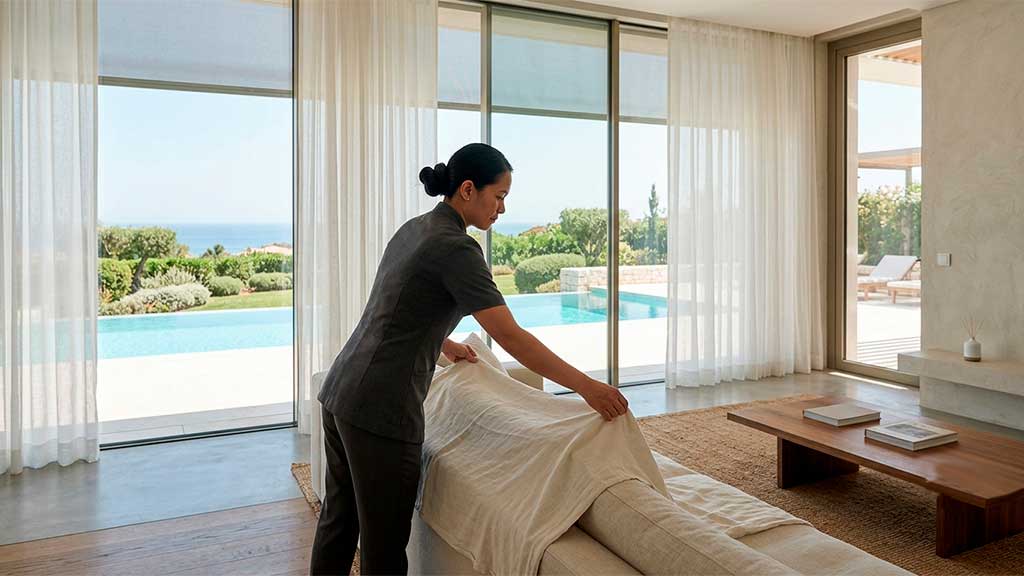
Contemporary luxury is no longer measured solely by the opulence of materials or a property’s location, but by the environment’s ability to invisibly adapt to the biological needs of its inhabitants. In the exclusive villas of the Portuguese coast, from contemporary properties exposed to the Atlantic wind in Cascais to the grand estates of the Algarve, thermal comfort stands as a fundamental pillar of well-being. During the summer season, these residences face a complex climate challenge: maintaining an optimal and homogeneous indoor temperature against intense solar radiation during the day and unexpected thermal drops caused by the sea breeze at sunset. Ensuring that a large-scale property maintains a fresh, balanced, and healthy atmosphere is not a task that can be completely delegated to an automated thermostat. It demands proactive and sophisticated human management. The staff selected by Luxury Philippines Domestic Services Portugal master this discipline, fusing technological control of state-of-the-art climate systems with an expert curation of light textiles to design the perfect microclimate in every room of the villa.
Technological Synchronization: Proactive Regulation of Climate Systems
A luxury villa features multiple orientations and zones with radically opposite thermal dynamics. The Filipino staff operates under specific protocols to avoid the two major mistakes of summer: overheated rooms and artificially frigid interiors.
Dynamic Management of Climate Zones and Air Flows
The Filipino staff does not just set a standard temperature on the house’s centralized system. They understand that thermal comfort is dynamic. Using home automation control screens, the team monitors thermal variations throughout the day. They independently regulate east-facing rooms during the morning and large glass lounges facing west during the afternoon. Their goal is to maintain a healthy thermal differential with the exterior (usually between and ), avoiding direct air currents over resting areas and ensuring that the transition between the interior and the gardens is smooth and pleasant for the owners.
Hygienic Maintenance and Indoor Air Quality (IAQ)
Intensive use of air conditioning during summer can dry out the environment or compromise air quality if left unmonitored. The Filipino staff performs strict control over the relative humidity levels of the villa, always keeping them in the optimal range of 40% to 60% through the coordinated use of integrated humidifiers. Likewise, they take care of supervising the periodic cleaning of diffusers and the air renewal in the early hours of the morning, guaranteeing that the house’s atmosphere is not only fresh but pure, allergen-free, and deeply revitalizing.
Textile Architecture: Curating Natural Fibers for Summer
Heat control is not only achieved through the house’s engineering; skin contact with the property’s surfaces determines the psychological perception of freshness.
Seasonal Transition from High-Density Linen to Lightweight Yarns
With the arrival of summer, the Filipino staff executes a complete shift in the villa’s textile configuration. Cashmere blankets, velvets, and winter bedspreads are stored away to make room for noble materials of high breathability. The beds in the master suites are dressed exclusively in washed Belgian linen or long-staple Egyptian cotton with a thread count optimized to allow air circulation. This meticulous selection ensures that, even on Portugal’s warmest nights, the sleep experience is fresh, soft, and restorative, without relying on aggressive artificial climate control.
Passive Solar Protection Through Luxury Curtains and Blinds
Large glass panels, characteristic of high-end architecture in Portugal, are massive sources of radiant heat. The Filipino staff implements passive solar protection techniques by smartly managing window textiles. During hours of maximum sunlight, they strategically deploy micro-perforated technical blinds and translucent linen curtains. This action blocks infrared rays without reducing the home’s luminosity, protecting both the thermal comfort of the living rooms and the integrity of fine wood furniture and artwork against solar wear.
Comfort in Transition Spaces: The Indoor-Outdoor Link
Summer in Portugal is lived, primarily, on terraces, porches, and pool areas. The true challenge of luxury service is ensuring that thermal comfort accompanies the client when they decide to step outdoors.
Thermal Conditioning of Al Fresco Living Areas
Outdoor spaces require constant attention to combat the radiant heat from stone or teak pavements. Before the family moves to the porch or chill-out areas, the Filipino staff prepares the outdoor microclimate. This includes activating subtle misting systems with purified water if the day is very dry, strategic placement of low-noise outdoor design fans, and arranging technical marine textiles that repel heat on the sun loungers. The owner thus finds an oasis of freshness right outside, perfectly climate-controlled to enjoy an afternoon of reading or relaxation.
Conclusion
Managing thermal comfort in a summer villa is an invisible choreography that directly impacts the mood, health, and vitality of its residents. By entrusting the property to the staff selected by Luxury Philippines Domestic Services Portugal, owners ensure that every room maintains a perfect thermal balance. The cultural sensitivity of the Filipino staff, combined with their technical skill, transforms the residence into a climactically intelligent refuge. The heat of the outdoor summer dissolves upon crossing the threshold, giving way to an atmosphere of serene freshness, textile lightness, and absolute well-being tailored to high-end standards.